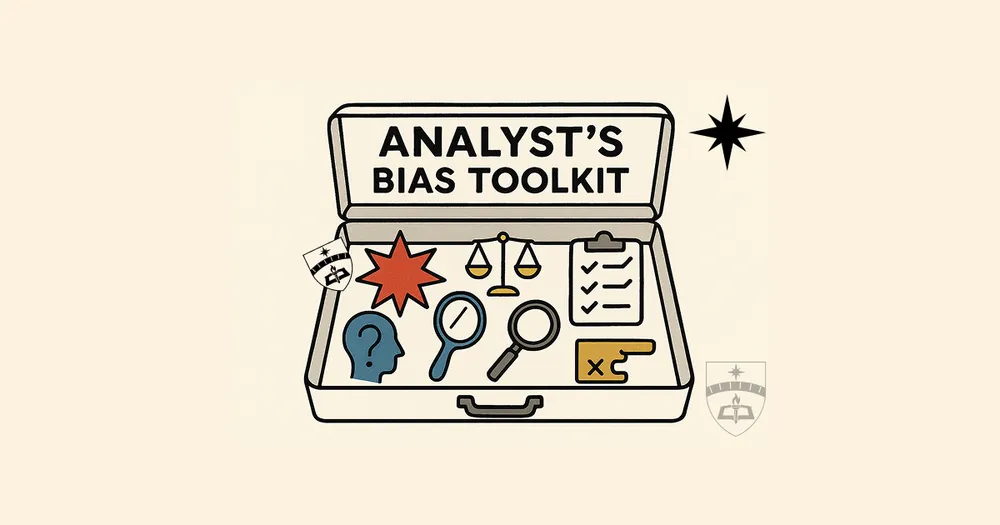
Bias is unavoidable - but in many cases, simply being aware of how the brain works can help mitigate the impact.
“Bias.” It’s a loaded word. More than that, it’s been talked about for decades (centuries, really) and for good reason. It’s incredibly important, yet stubbornly difficult to address adequately.
After spending October writing about bias, I’ve realized how vast the subject is—and how easy it is to talk about it in generalities instead of specifics. One useful insight came from the Alan Turing Institute, which classifies bias into three broad categories:
- Societal Bias – The systemic and cultural influences we usually think of when the topic comes up.
- Statistical Bias – Distortions caused by how data is gathered, selected, or represented.
- Cognitive Bias – The shortcuts and heuristics built into human thinking.
All three affect the quality of what we produce, whether that’s a report, decision, dashboard, recommendation, or policy. My work this month focused on cognitive bias, with brief detours into statistical. Even that narrow slice is deeper than one might expect.
From Awareness → Mitigation → Disciplined Structure
When I started this series, my goal was awareness: to remind ourselves that bias isn’t just something other people have—it’s built into how we all think.
But awareness isn’t enough. Once you recognize bias, the next step is to mitigate it through deliberate habits—slowing down, checking assumptions, and inviting alternative perspectives.
Beyond mitigation lies discipline; the point where inquiry, structure, and reflection become routine. This is where awareness turns into practice, and practice into craft.
The same way physical hygiene prevents illness, decision hygiene (a term popularized by Daniel Kahneman, Cass Sunstein, and Olivier Sibony) prevents analytic errors by reducing both bias and noise.
Good analysis doesn’t eliminate bias; it constrains it through disciplined structure.
A Non-Exhaustive List of Bias
Over the month we explored eight of the most common cognitive biases analysts face:
- Anchoring – Fixating on the first number or impression.
- Availability – Judging likelihood by what’s easiest to recall.
- Confirmation – Seeking evidence that supports our expectations.
- Representativeness – Trusting patterns that “look right.”
- Overconfidence – Overestimating the accuracy of our analysis.
- Hindsight – Believing we “knew it all along” after the fact.
- Framing – Letting presentation shape interpretation.
- Attribution – Judging work based on who did it, not what it says.
Other cognitive traps to be aware of
- Loss Aversion – Overweighting potential losses relative to equivalent gains. Losing $100 feels worse than winning $100 feels good.
- Sunk Cost Fallacy – Continuing a course of action because of past investment, even when future outlook no longer justifies it.
- Halo Effect / Horn Effect – Letting one positive (or negative) trait color everything else.
- Affect Heuristic – Letting emotions substitute for analysis. Feeling good about something becomes confused with something being good.
Not every thinking error fits neatly into the “bias” category, but these effects shape how bias appears in teams and individuals:
- Dunning–Kruger Effect – Limited expertise leads to overconfidence; true expertise often brings humility.
- Clance–Imes Phenomenon (Impostor Syndrome) – Competent individuals underestimate themselves and hesitate to contribute.
- Groupthink – Social harmony overrides independent judgment.
Together, these effects don’t distort what we think—they distort who speaks up and whose thinking gets heard.
What to Do About It
1. Before You Start
Bias prevention begins before the analysis does.
- Set clear guidelines and standards.
- Include diverse stakeholders and reviewers early.
- Ask: “If I wanted to attack this result, where would I start?”
2. During the Process – Apply Decision Hygiene
Borrowed from Noise (Kahneman, Sunstein, and Sibony), decision hygiene means cleaning up the decision process itself.
Break complex judgments into independent parts, evaluate each, and only then synthesize. Aggregate independent judgments rather than group opinions.
Ask sharper questions:
- Instead of “Is this data representative?” ask “Is X, Y, and Z represented here?”
- Instead of “What would it take to prove this wrong?” ask “How would I prove this wrong if I had to?”
3. Use Checklists
Checklists are underrated. They make good habits repeatable.
- Identify which biases are most likely to appear in your workflow.
- Write questions that help surface them.
- Review them before, during, and after analysis.
A checklist only works if you use it, not if you admire it.
4. Red Team / Pre-Mortem
Imagine it’s six months later and your project failed spectacularly. Now list every reason why. A red team actively tries to prove you wrong. Both expose blind spots optimism hides.
5. Independent Review
Seek outside eyes—people not invested in the outcome. Proximity breeds blindness; independence catches what familiarity conceals.
6. Combine and Rotate
Different techniques work better at different stages. Rotate roles. Structured diversity beats size every time.
Where We Go From Here
This is an extraordinarily deep topic. Some of the greatest minds in psychology and philosophy—Kahneman, Popper, Dewey, Klein—have all contributed to it.
While this month focused on cognitive bias, the same practices help with statistical and societal bias—and even with noise (random variations in human judgment). Bias bends our reasoning; noise scatters it. Decision hygiene helps with both.
What we covered this month is just the beginning:
- Awareness of how bias operates
- Techniques to mitigate it
- Structures to discipline it
In the coming months, Pelorus will keep building on that foundation—exploring how disciplined inquiry and structured reasoning lead to better decisions, cleaner analysis, and stronger insight.